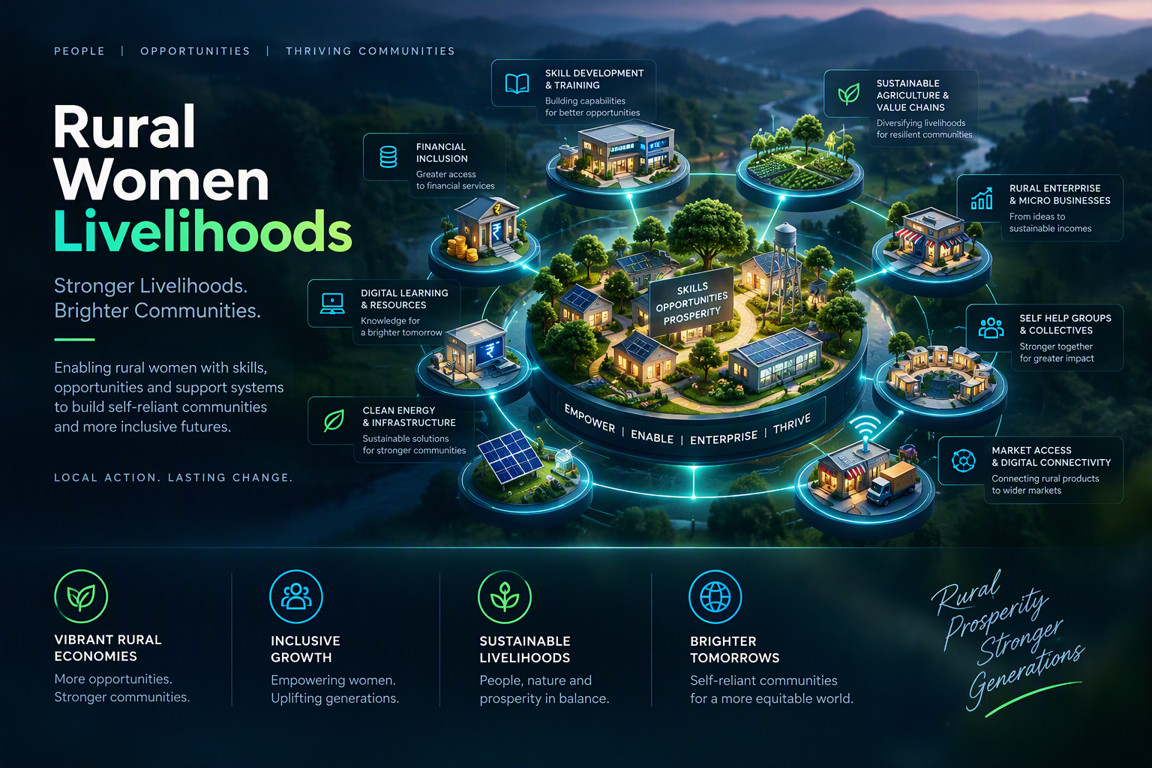
Pillar Overview: From Village to Economic Independence
Across rural Karnataka, women hold the ambition to earn, grow, and lead — but face persistent barriers: limited market access, weak financial systems, and gaps in digital and health literacy. Best People Foundation's Rural Women Livelihood & Community Development pillar directly addresses these structural challenges by enabling income generation, financial resilience, and community wellbeing across 6–8 villages.
Rather than delivering one-off workshops, this pillar builds durable, accountable community structures. We strengthen existing Self-Help Groups with governance and digital tools, equip women entrepreneurs with seed support and marketplace access, and deliver structured vocational and AI skills training programmes. Every initiative is tracked through simple digital impact tools to ensure outcomes are measurable and transparent.
This pillar creates a cascading effect: women who gain economic independence invest in their children's education, improve household health, and become advocates for further community development. Corporate CSR partners directly fund tangible livelihood outcomes — micro-enterprise kits, SHG capacity, shared digital infrastructure, and field operations across a network of rural villages.
Core Livelihood & Community Programmes
Our seven-component model addresses the full economic and social inclusion cycle for rural women:
Women-Led Micro Entrepreneurship
Seed support, tools, and structured enablement for women to launch and scale micro-enterprises across fashion, food processing, and local services — with hands-on digital marketplace exposure to reach wider markets.
Skill Development Centres & Training
Structured learning programmes of 15–20 sessions covering AI skills, vocational trades, financial literacy, and entrepreneurship fundamentals — delivered with digital learning tools tailored for first-time learners.
Self-Help Group (SHG) Strengthening
Capacity building for existing SHGs on governance, financial management, credit linkage, and effective use of digital coordination tools — transforming informal groups into resilient, self-sustaining economic institutions.
Digital Access Infrastructure for Women
Shared digital access points — devices and connectivity — enabling rural women to participate in financial inclusion, government scheme applications, online learning, and digital commerce without individual device ownership barriers.
Health, Nutrition & Hygiene Awareness
Community-led awareness drives of 10–12 structured sessions covering women's health, nutrition, hygiene practices, and digital access to verified health information and telemedicine platforms.
Programme Implementation & Field Operations
Dedicated on-ground coordination, community mobilization, and field staff support across 6–8 villages — ensuring consistent programme delivery, participant follow-up, and adaptive field responses.
Monitoring, Evaluation & Impact Reporting
Systematic tracking of participation rates, livelihood outcomes, income improvements, and programme effectiveness using accessible digital tools — enabling transparent, auditable reporting for CSR partners and donors.
Measurable Economic & Community Outcomes
Income Generation & Financial Resilience
Women-led micro-enterprises and market-linked skills directly increase household income, reducing dependence on seasonal agricultural cycles and male-only earning structures.
Stronger Community Institutions
Empowered SHGs with improved governance and digital tools become long-term financial safety nets and advocacy bodies for women's rights and community resource access.
Digital & Health Equity
Shared digital infrastructure and health literacy sessions reduce the urban-rural gap in access to information, government schemes, and preventive healthcare for women and their families.
Sponsor Rural Women's Economic Independence
Partner with Best People Foundation to fund micro-enterprise kits, SHG capacity building, shared digital access infrastructure, and field operations across rural village clusters — eligible under CSR Schedule VII (ii) and (x).